☯️ Layer 1: The Tradition — Qi, Yin-Yang, and The Five Elements
To understand TCM, we must first discard the Western mechanical view of the body (where organs are isolated parts like a car engine). In TCM, the body is a garden. A garden doesn't suffer from a "part" breaking; it suffers from poor soil, improper irrigation, or harsh weather.
The Concept of Qi (Vital Energy)
Qi (pronounced "chee") is the central foundation of Chinese medicine. It is the vital life force—the invisible electromagnetic energy that animates all living things. Qi flows through the body in specific pathways or rivers known as Meridians.
When Qi flows freely, the garden thrives: digestion is strong, the mind is clear, and the skin glows with an inner vitality that modern cosmetics refer to as "radiance." When Qi is blocked or stagnates, disease manifests. For example, a blockage of Qi in the Liver meridian often manifests as hormonal breakouts along the jawline.
Yin and Yang: The Law of Balance
Yin and Yang represent the fundamental duality of the universe. They are opposite, yet complementary forces that cannot exist without each other.
- Yin: Cool, dark, moist, and receptive (Water/Earth). In the body, Yin represents blood, structural tissues, and the cooling, hydrating fluids that keep the skin plump.
- Yang: Hot, bright, dry, and active (Fire/Sun). In the body, Yang represents metabolic heat, digestion, and the energy required to transform food into Qi.
A beautiful complexion requires perfect harmony between Yin and Yang. Too much Yang (Heat) causes inflammatory acne and rosacea. Not enough Yin (Moisture) causes premature aging and paper-thin, dry skin.
The Five Elements (Wu Xing)
TCM categorizes the entire universe, including our biological systems, into Five Elements: Wood, Fire, Earth, Metal, and Water. Every organ in your body, and every skin condition, corresponds to one of these elements.
- Wood (Liver/Gallbladder): Governs the smooth flow of emotions and detox. Imbalance leads to stress-induced breakouts.
- Fire (Heart/Small Intestine): Governs blood circulation. Imbalance leads to a ruddy complexion or chronic redness.
- Earth (Spleen/Stomach): Governs digestion and the transformation of food into energy. A weak Earth element leads to "Dampness," causing cystic, slow-healing acne.
- Metal (Lungs/Large Intestine): The Lungs literally "rule" the skin in TCM. They control the opening and closing of pores. Imbalance leads to dryness and eczema.
- Water (Kidneys/Bladder): The deepest reservoir of your vital essence (Jing). Imbalance leads to dark under-eye circles and bone-deep fatigue.
🔬 Layer 2: The Mechanism — Why TCM Works
It is easy to dismiss terms like "Qi" and "Meridians" as metaphor, but modern clinical research is proving that the ancient Chinese mapped the human nervous and fascial systems long before the invention of the microscope.
Meridians and Fascial Planes
For decades, Western doctors searched for physical "tubes" that carried Qi, finding nothing. However, recent ultra-sound and MRI studies have revealed that the 12 main TCM Meridians correspond almost perfectly to the body's **fascial planes**—the continuous web of connective tissue that encases our muscles and organs.
Fascia is highly conductive. When an acupuncturist inserts a needle (or when you use a Gua Sha tool), it creates a micro-mechanical stretch in the fibroblasts of the connective tissue. This mechanical signal is converted into an electrical signal that travels through the fascia, triggering the release of adenosine—a powerful, natural anti-inflammatory molecule that prompts cellular repair locally and systemically.
The Meridian Clock & Chronobiology
TCM posits that Qi flows into different organs at specific 2-hour intervals. For example, the Liver Window is from 1 AM to 3 AM. This is when the body performs its deepest blood filtration and detoxification.
Western science now calls this Chronobiology. We’ve discovered that specific enzymes required for liver detoxification literally peak in the middle of the night. If you are awake at 2 AM doom-scrolling, you are diverting blood flow from the liver to the brain and eyes, interrupting your body's nightly detox sweep. The result? A toxic buildup that appears on your skin as a dull, grayish pallor the next morning.
✨ Layer 3: Modern Application — The Way of Yang Sheng
In TCM, the ultimate goal is not just curing disease, but Yang Sheng—the art of "Nourishing Life." Here is how you can practically apply this 2,500-year-old intelligence to your daily routine for profound beauty benefits.
1. The Ritual of Facial Gua Sha
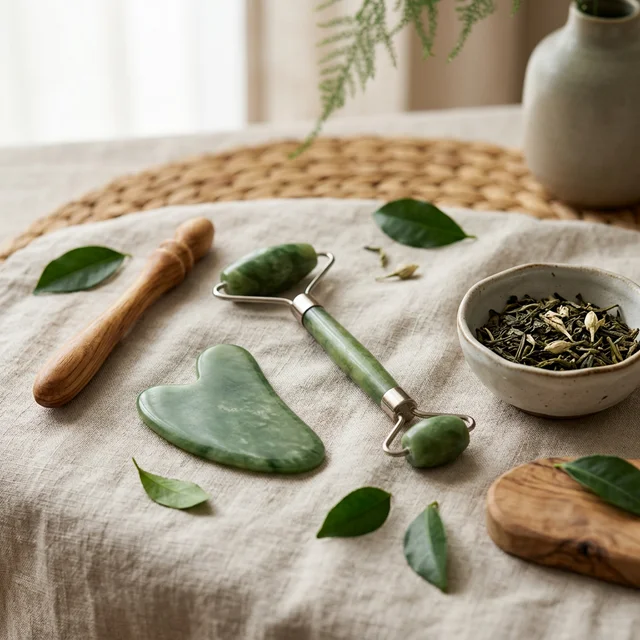
Gua Sha (direct translation: "scraping sand") was historically used vigorously on the back to release heat and pathogens. For the face, a gentler approach using a smooth jade or rose quartz tool is employed.
How to do it: Apply a high-quality barrier oil (like Squalane or Rosehip). Using the flat edge of your tool, gently stroke upwards and outwards from the center of your face. The Clinical Effect: Laser doppler imaging shows that 5 minutes of Gua Sha increases surface microcirculation by a massive 400%. This flood of fresh blood brings oxygen to the dermis, while the mechanical scraping physically moves stagnant lymphatic fluid down the neck, instantly reducing puffiness and defining the jawline.
2. Face Mapping (Mien Shiang)
TCM teaches that the face is an exterior map of the interior organs. Discover the full Clinical Authority Guide to Chinese Face Mapping (Mien Shiang).
- Forehead (Heart/Intestines): Breakouts here indicate poor diet, too much refined sugar, or poor sleep.
- Cheeks (Lungs/Stomach): Breakouts here indicate respiratory stress (allergies or smoking) or a sluggish metabolism.
- Jawline/Chin (Kidneys/Reproductive): Almost exclusively hormonal. This indicates a deep Yin/Yang imbalance often caused by chronic stress or the menstrual cycle.
Instead of just applying topical salicylic acid to jawline acne, someone practicing TCM would simultaneously focus on stress reduction (lowering cortisol) and eating grounding, Earth-element foods to balance the hormones internally.
3. Drinking Warm Water
This is perhaps the simplest, yet most ignored TCM rule in the West. Your "Earth" element (the Spleen/Stomach) requires warmth to "cook" your food and extract Qi. Drinking ice water with meals literally douses your internal fire, slowing digestion, freezing dietary fats in the gut, and creating that sluggish "Damp" condition that leads to acne and bloating. Switch to room temperature or warm water.
🛒 Ritual Essentials: Recommended Support
Certified Jade Gua Sha Facial Tool
Master the art of Yang Sheng. This genuine Xiuyan Jade tool is designed to lift the face, sculpt the jawline, and increase microcirculation by up to 400%.
View on Amazon →Double-Sided Rose Quartz Roller
A cooling, soothing ritual for inflammatory skin. Rose quartz remains naturally cold, helping to constrict blood vessels and reduce redness (excess Yang) instantly.
View on Amazon →🌍 Establish Your Holistic Authority
Understanding Qi, Meridians, and the Five Elements is a profound step toward holistic mastery. However, TCM is part of a much larger, global conversation about natural medicine.
Step 2: Connect the Global Medical Systems
Did you know that TCM's "Five Elements" share incredible similarities with Ayurveda's "Three Doshas" and the Greek "Four Humors"?
👉 Mandatory Next Read: See how it all connects in our massive 4,500-word master guide: Ancient Healing Systems: The Global Authority Guide. Discover the Silk Road of medicine and build your ultimate daily ritual.
Recommended Products
Discover quality skincare products endorsed by experts: