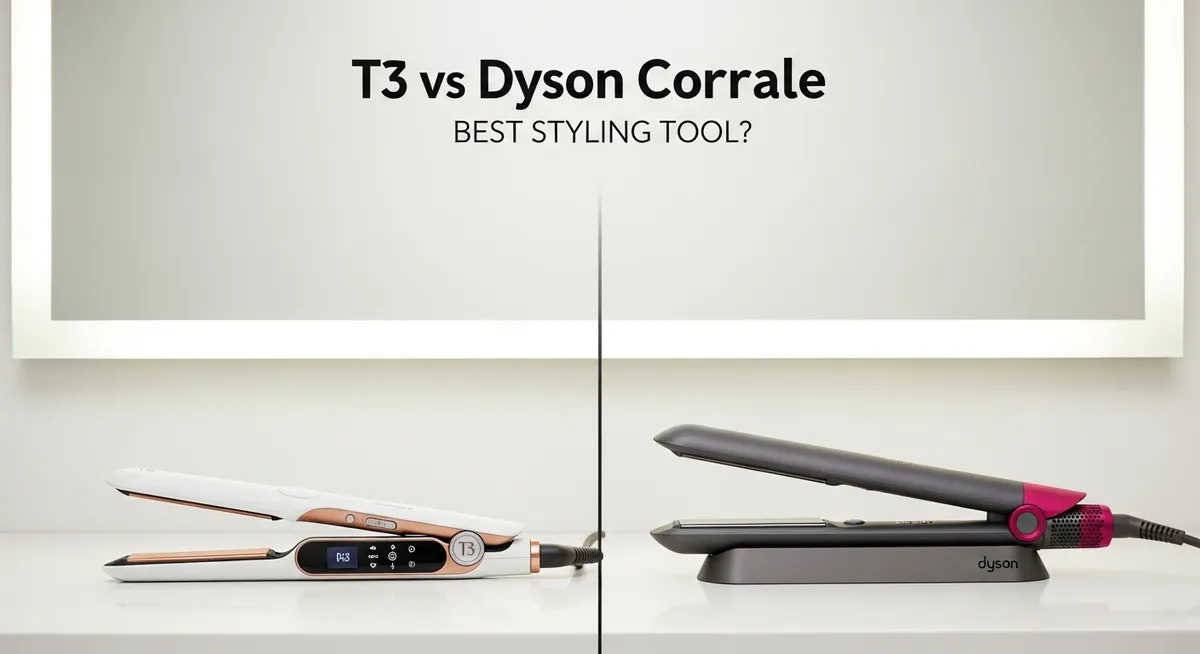
📊 T3 vs Dyson: Comparison Table
| Feature | T3 | Dyson |
|---|---|---|
| Best For | Heat Tech & Renewal | Cordless & Maintenance |
| Skin Types | Oily / Aging / Acne | Dry / Sensitive / Normal |
| Key Benefits | Resurfacing, Potency | Hydration, Soothing |
| Results Speed | 4-12 Weeks | Immediate - 2 Weeks |
| Ease of Use | Moderate (Requires care) | High (Easy to use) |
| Price Range | $$$ | $$ |
What is T3?
T3 is widely regarded as a powerhouse in the skincare world. Fundamentally, it works by utilizing high-tech engineering. It is the go-to choice for users looking to aggressively tackle specific concerns like texture, pigment, or cell turnover.
Related Reading: Explore our guide on Cerave Vs Cetaphil Cleanser.
Who should use it?
If you have built up a basic routine and are ready to level up, T3 is your next step. It's ideal for those seeing the first signs of aging or stubborn breakouts.
🏆 Best T3 Picks
Best Overall T3
The top-rated T3 choice that balances efficacy with tolerability. consistently praised for delivering visible results.
Pros
- Top rated by users
- Clinically effective
- High quality ingredients
Cons
- Price varies
Best Budget T3
A wallet-friendly option that doesn't skimp on the active ingredient. Perfect for beginners testing the waters.
Pros
- Affordable
- Accessible
- Good entry point
Cons
- Simpler formulation
Best Premium T3
A splurge-worthy treatment that combines T3 with soothing botanicals and peptides for a premium experience.
Pros
- Advanced formulation
- Elegant texture
- Added beneficial ingredients
Cons
- Expensive
What is Dyson?
Dyson, on the other hand, offers a different approach. It focuses on focusing on manual or simplified operation. This makes it an incredibly versatile player in any routine, often serving as the "support system" that keeps your skin healthy and balanced.
Who should use it?
Anyone can benefit from Dyson. It is particularly favored by those who want to improve Cordless without the risk of irritation associated with stronger actives.
🏆 Best Dyson Picks
Best Overall Dyson
The top-rated Dyson choice that balances efficacy with tolerability. consistently praised for delivering visible results.
Pros
- Top rated by users
- Clinically effective
- High quality ingredients
Cons
- Price varies
Best Budget Dyson
A wallet-friendly option that doesn't skimp on the active ingredient. Perfect for beginners testing the waters.
Pros
- Affordable
- Accessible
- Good entry point
Cons
- Simpler formulation
Best Premium Dyson
A splurge-worthy treatment that combines Dyson with soothing botanicals and peptides for a premium experience.
Pros
- Advanced formulation
- Elegant texture
- Added beneficial ingredients
Cons
- Expensive
Key Differences Explained
- Texture: T3 formulations tend to be more potent and sometimes drying, while Dyson is often lusher and more hydrating.
- Strength: T3 is the heavy lifter. Dyson is the gentle supporter.
- Results Speed: You will feel Dyson working almost immediately (softness/hydration). T3 requires patience (cell turnover cycle is ~28 days).
- Side Effects: T3 can cause purging or peeling. Dyson rarely causes adverse reactions.
- Price: Generally, high-quality T3 commands a higher price due to stabilization requirements.
Which is Better for Your Skin Type?
Oily Skin
Winner: T3. Its ability to turn over cells and unclog pores makes it superior for regulating oil production.
Dry Skin
Winner: Dyson. The hydrating factors typically associated with Dyson formulations are a savior for dry patches.
Sensitive Skin
Winner: Dyson. Use caution with T3; if you must use it, look for buffered low-dose versions.
Acne-Prone Skin
Winner: T3. It attacks the root cause of congestion better than Dyson.
Mature Skin
Winner: Both. Ideally, you use T3 to treat wrinkles and Dyson to maintain plumpness.
Pros & Cons Summary
T3 Pros & Cons
✅ Pros
- Proven efficacy
- Targets deep concerns
- Professional grade results
❌ Cons
- Can be irritating
- Higher price point
- Sun sensitivity risk
Dyson Pros & Cons
✅ Pros
- Very gentle
- Instant gratification (feel)
- Affordable options
❌ Cons
- Less dramatic results
- Subtle long-term changes
Can You Use Both Together?
Yes, absolutely. In fact, they often complement each other perfectly. The key is timing.
Example Routine
- Morning: Cleanse, Apply Dyson (if suitable for day), SPF.
- Night: Cleanse, Apply T3 (active step), Moisturizer.
⭐ Final Verdict
Both ingredients deserve a place in the skincare hall of fame, but for different reasons.
- Best Overall Winner: We give the edge to T3 for its ability to truly transform the skin structure.
- Best for Beginners: Dyson is the safest place to start.
- Best Budget Option: Dyson products are generally more wallet-friendly.
- Best Premium Option: A high-quality T3 serum is worth the spluge.
Frequently Asked Questions
1. How long does it take to see results?
For T3, expect 4-8 weeks. For Dyson, you might see benefits in 1-2 weeks.
2. Can I use these if I'm pregnant?
Always consult your doctor. Generally, Dyson is safer, while many forms of T3 (especially retinoids) are not recommended.
3. Do I really need specific products?
Yes. Formulation matters. A poorly formulated T3 product can cause irritation without results.
4. Which one is better for wrinkles?
T3 is significantly better for deep static wrinkles.
5. Is it safe to use daily?
Dyson is usually safe for daily use. T3 should be built up slowly, starting 2-3 times a week.

Ivana Dsouza
Beauty editor and skincare researcher at NxtLifestyle. Dedicated to finding scientifically-backed products that actually work.