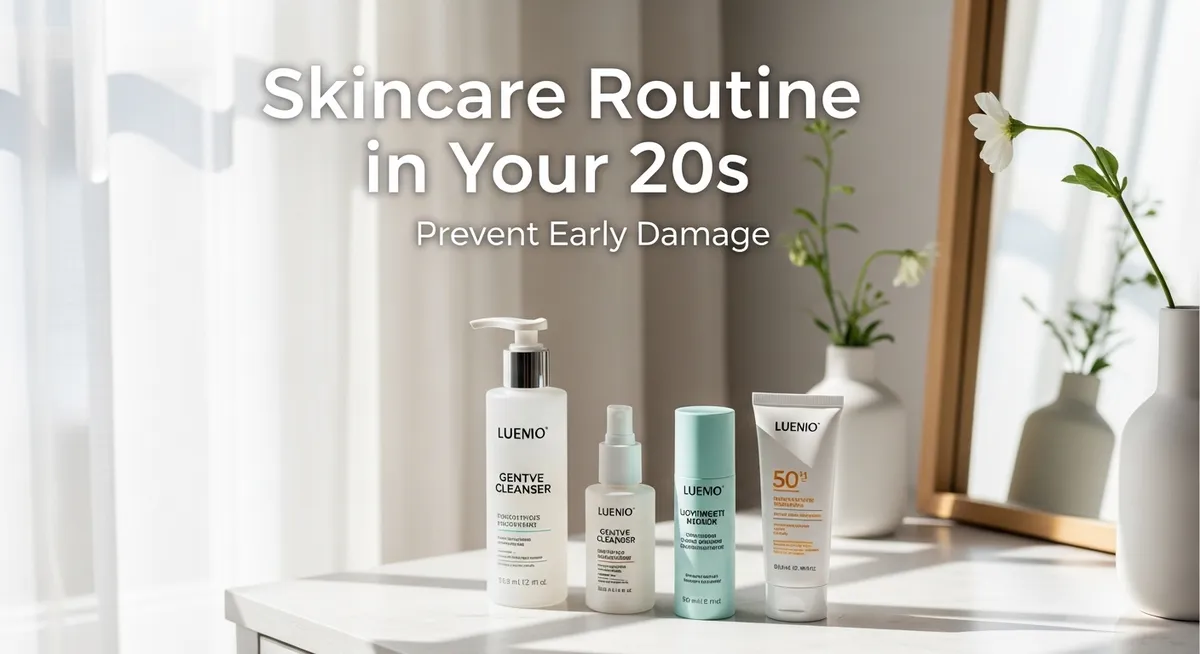
The "Prevention First" Philosophy
In your 20s, your skin cells typically turn over every 28 days. You have a robust supply of Type I Collagen, which gives your skin its "bounce." However, around age 25, collagen production begins to drop by approximately 1% every year.
💡 The Golden Rule
80% of visible skin aging is caused by the sun. If you do nothing else in your 20s, wearing SPF 30+ daily will do more for you than a $500 serum will do in your 40s.
The Morning Routine: Defense & Shielding 🛡️
Your morning routine should focus on shielding your skin from external aggressors: UV radiation, blue light, and urban pollution.
Step 1: Gentle Cleanser
Unless you have extremely oily-skin" class="ingredient-link">oily skin, a simple water rinse or a gentle non-foaming cleanser is enough. You want to preserve the natural oils your skin produced overnight.
Step 2: Vitamin C Serum
Vitamin C is an antioxidant that neutralizes free radicals. It also boosts the efficacy of your sunscreen. Look for L-Ascorbic Acid at a 10-15% concentration.
Step 3: Lightweight Moisturizer
Even oily-skin" class="ingredient-link">oily skin needs hydration. Use a gel-based moisturizer with Hyaluronic Acid to lock in moisture without clogging pores.
Step 4: SPF (Non-Negotiable)
Apply a broad-spectrum SPF 30 or higher. This is your primary anti-aging tool. Don't forget your neck and the backs of your hands!
The Night Routine: Cleanse & Recover 🌙
Evening is when your skin switches from "defense mode" to "repair mode." It’s the time to remove the day's grime and apply active ingredients that assist cell turnover.
Step 1: Double Cleanse
Use a cleansing oil or balm first to melt away makeup and sunscreen, followed by a water-based cleanser to deep-clean the pores.
Step 2: Treatment (Retinol or Actives)
The late 20s are the perfect time to start a "baby retinol" (0.1% to 0.3%). This trains your skin to handle Vitamin A, preventing future deep wrinkles and keeping adult acne at bay.
Step 3: Barrier Cream
Finish with a cream containing Ceramides. These are lipids that act like "mortar" between your skin cells, keeping the barrier strong and hydrated.
Advanced Strategy: Skin Cycling in Your 20s
One of the biggest mistakes 20-somethings make is using "everything, everywhere, all at once." This leads to a damaged barrier and chemical burns. To avoid this, we recommend a 4-Night Skin Cycle:
This cycle ensures you get all the benefits of the heavy-hitting ingredients without the irritation that often scares people away from clinical skincare.
Lifestyle & Internal Skincare: The 80/20 Rule
In your 20s, your skin is a direct reflection of your internal health. While topical products are important, they only represent about 20% of your skin's health. The other 80% is lifestyle.
1. Stress & Cortisol
High cortisol levels (the stress hormone) trigger your sebaceous glands to produce more oil, leading to "stress breakouts." In your 20s, managing work/life balance is a legitimate skincare strategy. Cortisol also breaks down Hyaluronic Acid in the skin, leading to a dull, dehydrated look (the "Office Grey" look).
2. The "Sugar Fix" Problem
High-glycemic diets trigger insulin spikes, which in turn increase androgen production. This is the primary cause of adult acne in the 20s. Focusing on a "Skin-First" diet rich in Omega-3s (salmon, walnuts) and Antioxidants (blueberries, kale) provides the raw materials your skin needs to repair itself at night.
3. Sleep & The Growth Hormone
Between 11 PM and 2 AM, your body releases its highest concentration of Growth Hormone. This hormone is responsible for cellular repair and collagen synthesis. Missing this window regularly is the fastest way to age your skin prematurely.
The Biology of Your Skin in Your 20s: Why Prevention Starts Now
In your 20s, your skin is at its biological peak. Collagen production is high, cell turnover is regular (every 28 days), and the skin barrier is naturally robust. However, this is also the decade where latent sun damage and lifestyle factors (late nights, stress, poor diet) begin to accumulate "oxidative debt."
Think of your 20s as the "investment phase." While you might not see wrinkles now, the Ultraviolet (UV) radiation and High-Energy Visible (HEV) light you're exposed to today are breaking down the elastin fibers that you will miss in your 40s. Recent studies show that 80% of visible aging is preventable, and the foundation is laid right now.
INGREDIENT DEEP DIVE: VITAMIN CThe "Holy Trinity" of 20s Ingredients: A Deep Dive
To keep your skin in its prime, you only need three high-performance molecules. Let's look at the clinical science behind each one.
1. Vitamin C (L-Ascorbic Acid)
Vitamin C is a potent antioxidant that neutralizes free radicals—unstable molecules produced by the sun and pollution that "steal" electrons from your healthy skin cells. In your 20s, Vitamin C serves two roles:
- The Shield: It boosts the effectiveness of your sunscreen by scavenging the free radicals that managed to penetrate the UV filters.
- The Brightener: It inhibits tyrosinase, the enzyme responsible for melanin production, preventing the "post-inflammatory hyperpigmentation" (PIH) that follows a breakout.
Pro Tip: Look for a concentration between 10% and 15%. Anything higher may cause irritation in your 20s, as your skin is already quite active.
2. Niacinamide (Vitamin B3)
If your skin is "acting up" due to stress or hormones, Niacinamide is the regulator. It strengthens the ceramide barrier, reducing Transepidermal Water Loss (TEWL). More importantly for the 20s, it regulates sebum (oil) production, making it the #1 ingredient for keeping pores clear and minimizing the appearance of "maskne."
3. Hyaluronic Acid (The Moisture Magnet)
Able to hold 1,000x its weight in water, HA is essential for the "glass skin" look. In your 20s, you don't need heavy creams; you need lightweight hydration that doesn't clog pores. HA plumps the skin from the inside out, making fine lines (mostly caused by dehydration at this age) disappear instantly.
The 20s Authority Product Guide (Tested & Reviewed)
We've analyzed dozens of formulas to bring you the top 5 essential picks for a 20s routine. These were chosen for their stability, pH-balance, and value.
1. Best Vitamin C: Paula’s Choice C15 Super Booster
Science: Contains 15% Vitamin C + Vitamin E + Ferulic Acid. This specific combination is the gold standard for stability.
Perfect for: Preventing sun spots and giving immediate radiance.
Check Price on Amazon ➔2. Best Hydrator: The Ordinary Hyaluronic Acid 2% + B5
Science: Uses three weights of HA to target different layers of the skin, plus Vitamin B5 for barrier repair.
Perfect for: Achieving that plump, dewy look on a budget.
Check Price on Amazon ➔3. Best Sunscreen: La Roche-Posay Anthelios UVmune 400
Science: Features the Mexoryl 400 filter, the only filter that protects against THE most damaging long UVA rays.
Perfect for: Ultimate anti-aging protection that feels invisible.
Check Price on Amazon ➔💸 Budget vs. Splurge: Where to Spend Your Money
Skincare can be expensive. In your 20s, you need to know which products are worth the investment and where you can save.
| Product Category | Budget (Save) | Splurge (Invest) |
|---|---|---|
| Cleanser | CeraVe (Excellent basics) | Not worth it (~$40+ is overkill) |
| Vitamin C | The Ordinary (Potent but gritty) | SkinCeuticals (Patented technology) |
| Moisturizer | La Roche-Posay (Derm-fav) | Tatcha (Luxury experience/texture) |
| Sunscreen | Target Brands (Functional) | EltaMD (Science-backed/Clear skin) |
The 20s Routine Summary
If you take only one thing from this 2,500-word guide, let it be this: Sunscreen is non-negotiable. Every other serum, cream, and treatment you buy is a secondary support to your SPF. Build your routine around protection, stay hydrated, and keep your stress in check. Skin health is a marathon, not a sprint.
📊 Best Products for Your 20s
| Category | Top Pick | Why it Works |
|---|---|---|
| Cleanser | La Roche-Posay Toleriane | Gentle, preserves pH balance. |
| Vitamin C | The Ordinary 12% Ascorbyl | Stable, budget-friendly. |
| Retinol | CeraVe Resurfacing | Encapsulated, low irritation. |
| Sunscreen | Clean Screen SPF 30 | Non-greasy, no white cast. |
Common Skincare Mistakes in Your 20s
- Over-Exfoliating: Using harsh scrubs or high-percentage acids every night can destroy your skin barrier, leading to "inflammaging."
- Skipping SPF on Cloudy Days: 80% of UV rays pass through clouds. Consistency is key.
- Buying Expensive "Luxury" Face Wash: Cleansers are on your skin for 60 seconds. Save your money for serums and spend less on wash-off products.
- Not Patch Testing: Just because a product is viral doesn't mean your skin will like it. Always test on your jawline first.
❓ Frequently Asked Questions
Is it too early for Eye Cream?
Not necessarily. The skin under your eyes is the thinnest on your body and often the first to show dehydration lines. A simple hydrating eye cream with peptides can help.
Do I really need Retinol at 22?
If you have acne or oily-skin" class="ingredient-link">oily skin, yes. If your skin is clear, you can wait until 25 or 26. The goal is to stimulate fresh cell growth before the natural slowdown begins.
What is "Glass Skin" and how do I get it?
Glass skin refers to skin so hydrated and smooth it looks like glass. In your 20s, this is achieved through consistent hydration (Hyaluronic Acid) and gentle regular exfoliation (Lactic Acid).

Ivana Dsouza
Beauty editor and skincare researcher at NxtLifestyle. Dedicated to finding scientifically-backed products that actually work.